The Art of Opening Doors: Advent Calendar Traditions Across Germany
From chalk marks on doorframes to glittering printed scenes — how the German tradition of counting down to Christmas evolved over two centuries.
Before Calendars: Counting with Chalk and Candles
Long before printed advent calendars existed, German families found ways to count the days until Christmas. In 19th-century Lutheran households, it was common to draw 24 chalk marks on the door or wall, erasing one each day from December 1st. Catholic families in Bavaria and Austria often used Advent wreaths with four candles — one lit each Sunday of Advent — though this counted weeks rather than days.
The Advent candle clock, popular in Scandinavian-influenced northern Germany, was a tall candle marked with 24 lines. Each day, the family would burn the candle down to the next mark. Some families hung 24 small pictures on a string or tucked a Bible verse behind each one. The common thread was always the same: daily ritual, shared anticipation, and the slow build toward December 25th.
The Leap to Print
The first known printed advent calendar appeared around 1902, produced by a Hamburg bookseller. In 1908, the Munich publisher Gerhard Lang — inspired by a cardboard calendar his mother had made him as a child — began mass-producing calendars with small doors. Lang's company thrived until the 1930s, when wartime paper shortages forced it to close.
After the war, Richard Sellmer of Stuttgart revived the tradition with affordable, beautifully illustrated calendars. By the 1950s, the printed advent calendar had become a fixture of German Christmas culture. Every bakery, bookshop, and department store stocked them. Children learned to check their calendar first thing each morning — and the daily reveal of the hidden image became one of the most anticipated rituals of the season.
Regional Variations
Advent traditions vary across Germany's regions:
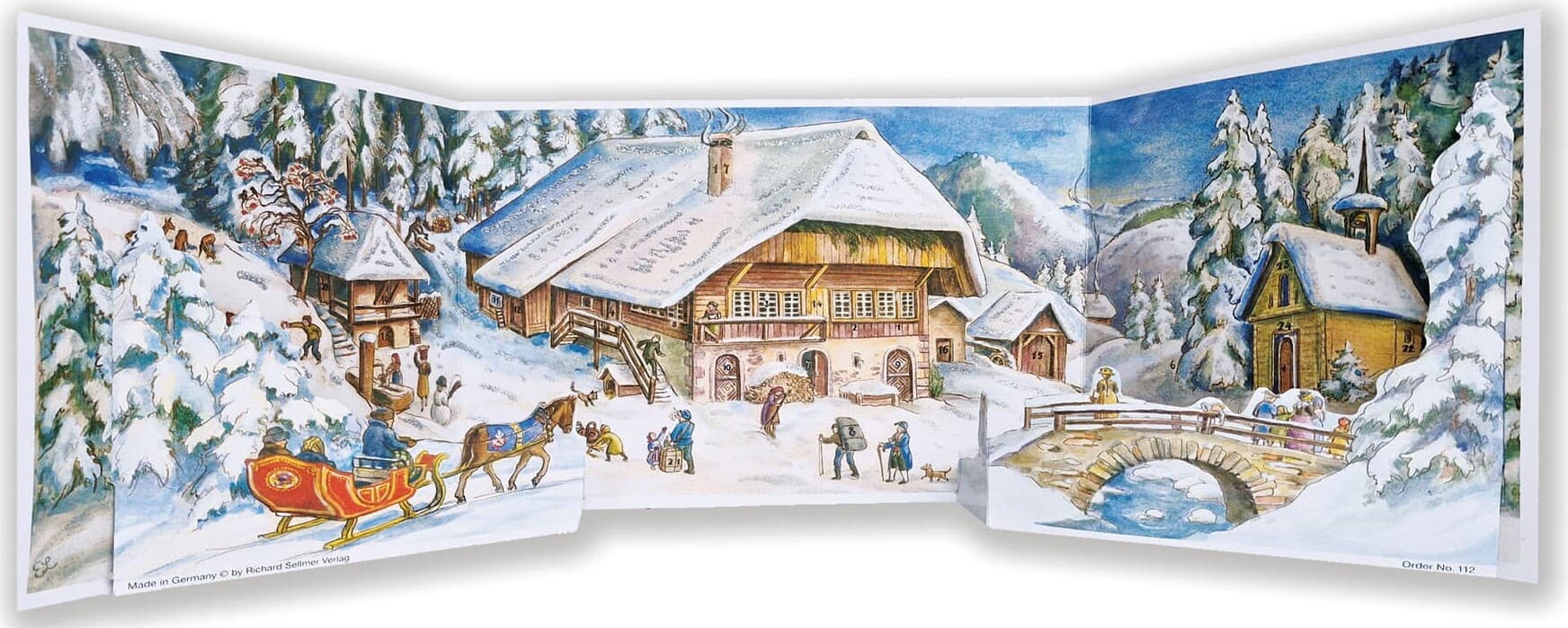
Northern Germany favors clean, traditional village scenes — half-timbered houses, church steeples, snow-covered landscapes. The aesthetic is understated and nostalgic. These are the calendars most closely descended from the original Sellmer designs.
Bavaria and Austria lean toward religious themes — nativity scenes, the Three Wise Men, angels, and shepherds. Larger, more ornate calendars with gold foil accents are popular. In some families, the calendar is placed near the family's Krippe (nativity scene) as part of a larger Christmas display.
The Rhineland has a strong connection to carnival culture, and this playfulness extends to advent calendars. Children's calendars with animals, elves, and fairy-tale scenes are especially popular in Cologne and Düsseldorf.
The Erzgebirge (Ore Mountains) of Saxony, famous for wooden Christmas crafts, has its own advent tradition: wooden advent "houses" with 24 small drawers, each containing a tiny carved figure or ornament. These complement, rather than replace, the printed calendar.
The Modern Calendar
Today's German households often have multiple advent calendars running simultaneously. Children might have a printed calendar on the wall, a chocolate calendar on the kitchen counter, and a LEGO or PLAYMOBIL calendar in the playroom. Adults increasingly have their own — tea advent calendars, cosmetics calendars, or gourmet food calendars are popular gifts.
But the traditional printed calendar endures. There's something irreplaceable about the physical act of opening a paper door — the small resistance of the perforation, the reveal of the hidden image, the daily conversation about what's behind today's window. In an age of instant digital gratification, the printed advent calendar is a counterpoint: a slow, analog ritual that makes waiting part of the joy.
Why It Matters
The advent calendar isn't just a countdown. It's a daily practice of anticipation — teaching children (and reminding adults) that good things are worth waiting for. In Germany, where the tradition originated, it remains one of the most deeply felt Christmas customs. A home without an advent calendar in December would feel incomplete, like a Christmas tree without ornaments.
The word "Advent" comes from the Latin adventus, meaning "arrival" or "coming." The season of Advent traditionally begins four Sundays before Christmas and is a time of preparation and expectation.